
BODY METRICS
What Your Body Is Telling You Overnight
July 16th 2026・by Andrej Mihelič
GENTLER 101
FITNESS
HEALTH
Your smartwatch can collect five key metrics while you sleep. Each one reflects a different aspect of your physiology, and together they paint a clear picture of how well you are recovering, and whether something might be off.
Sleeping Heart Rate
Your sleeping heart rate (SHR) is an average heart rate per minute while you are asleep. A lower number generally indicates a healthy and strong heart and good cardiovascular fitness. A declining SHR over time is a sign you are getting fitter. An elevated SHR, on the other hand, can signal fatigue, inadequate recovery, or early signs of illness before you are even aware of them.
You may notice a different sleeping heart rate in our apps than in Apple Health. Our SHR, as in most other health and fitness apps, is an average of all heart rate readings taken while you were asleep, whereas Apple's is usually lower and close or similar to the lowest reading taken overnight.
Heart Rate Variability
Heart rate variability (HRV) measures the variation in time between consecutive heartbeats. It is a good indicator of how well your body can adapt and respond to stress. High HRV indicates resilience and strong recovery capacity. Low HRV can point to fatigue, dehydration, anxiety, or illness, and may imply a need for rest. HRV is highly individualised and is affected by age, gender, and lifestyle, so what matters most is your personal trend rather than any absolute number.
Both apps, Gentler Streak and The Outsiders, offer two calculation methods. RMSSD is widely recognised as one of the most accurate ways to track the impact of training load and short-term recovery. SDNN is considered the gold standard for medical stratification of cardiac risk, and is also Apple's default method. For most athletes, RMSSD is the preferred method, which is why you may see different overnight HRV values in our apps than in Apple Health.
It is worth knowing that HRV is hard to measure well. It is very sensitive to anything you do, even breathing differently, so it is best measured during sleep, and you need lots of readings to get an accurate overnight value. Because Apple Watch only records a few HRV readings per night, both apps put more focus on sleeping heart rate than HRV.
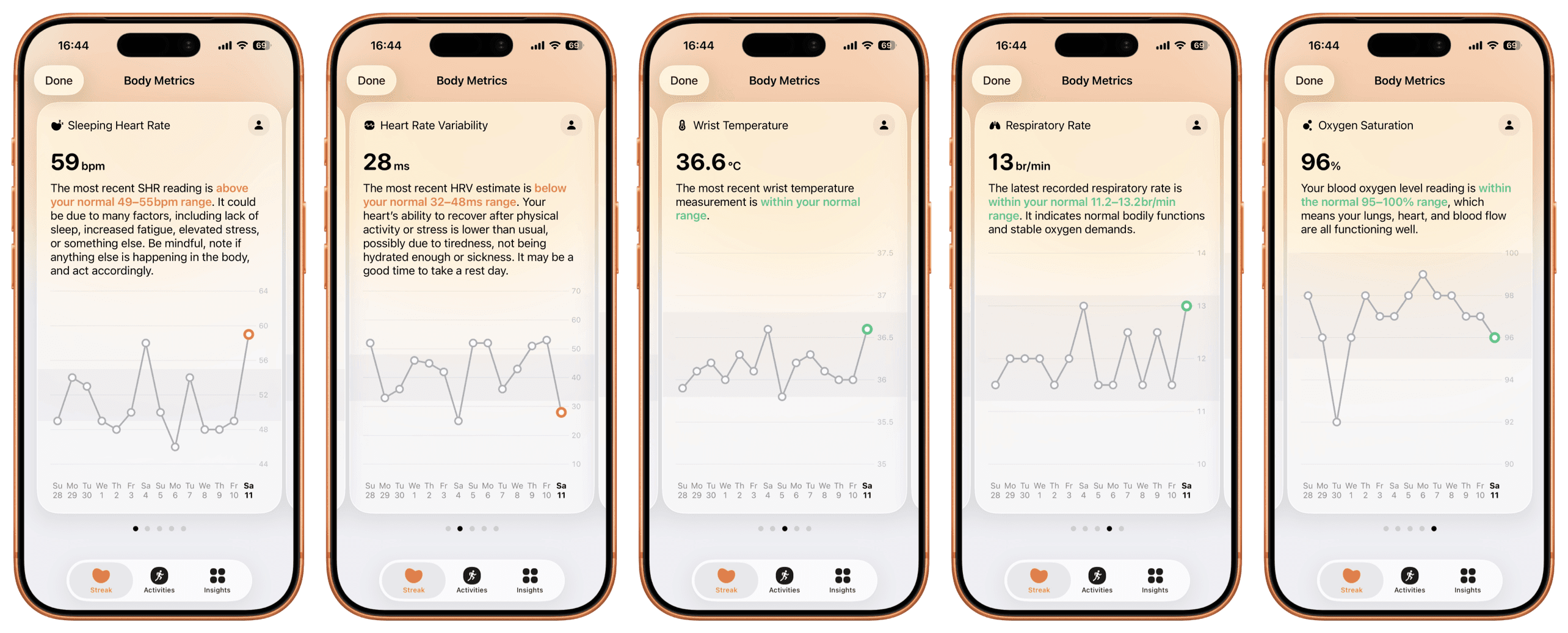
Gentler Streak focuses on your recovery today and how your latest activities affect it. It's designed for people who prefer simplicity over data obsession, unlike our more data-rich The Outsiders.
Wrist Temperature
Your wrist temperature is measured overnight. Everyone's baseline is different, and small fluctuations are normal due to factors like diet, exercise, alcohol consumption, menstrual cycles, illness, and sleep environment. A notable and sustained rise above your norm is often one of the earliest signs that your body is fighting something, sometimes before other symptoms appear.
Respiratory Rate
Respiratory rate is the number of times you breathe per minute. It is a general indicator of cardiovascular fitness and overall recovery. Your respiratory rate increases when your body needs more oxygen, which can be caused by a challenging training block, allergies or asthma, smoking, heavy alcohol consumption, illness, lack of sleep, or high altitude. An elevated overnight respiratory rate is often a reliable early warning sign of illness or overreaching. A low respiratory rate, on the other hand, is usually a sign you are well rested. That said, if your respiratory rate trends low over a longer period, it is worth mentioning to your doctor.
Blood Oxygen
Blood oxygen (SpO₂) represents the percentage of oxygen your red blood cells carry from your lungs to the rest of your body. It indicates how well your lungs, heart, and circulatory system are working. Blood oxygen levels typically range from 95 to 100%. Lower values during sleep, possibly below 95%, are normal and can be expected. However, readings consistently below 90% can be a sign that something is off and are worth paying attention to. Individual values vary.

Analyse your body metrics in depth in The Outsiders app with 7-day, 4-week, and 6-month views of your complete Apple Health history.
Why These Metrics Matter Together
No single metric tells the full story. The value of tracking all five is in the patterns they create together. A mildly elevated sleeping heart rate might be unremarkable on its own. Pair it with a drop in HRV, a slightly raised wrist temperature, and an elevated respiratory rate, and the picture becomes much clearer.
This is exactly how activity guidance in Gentler Streak and Training Readiness in The Outsiders use these metrics: not in isolation, but in combination with your training load and sleep quality. The Outsiders app also looks at your 7-day averages, not just last night's readings. If something has been off over the past week, that accumulated signal still has an effect on your readiness today, even if yesterday alone looked fine.
Frequently Asked Questions
What is a good sleeping heart rate?
A lower sleeping heart rate generally indicates a healthy, strong heart and good cardiovascular fitness. Everyone's baseline is different, so a declining trend over time matters more than any single number.
How reliable is HRV for tracking recovery?
HRV is a good indicator of how well your body can adapt and respond to stress, but it is hard to measure well. It is very sensitive to anything you do, even breathing differently, so it is best measured during sleep, and you need lots of readings to get an accurate overnight value. Because Apple Watch only records a few HRV readings per night, both apps put more focus on sleeping heart rate than HRV.
Should I use RMSSD or SDNN for HRV?
For most athletes, RMSSD is the preferred method, as it is widely recognised as one of the most accurate ways to track training load and short-term recovery. SDNN is the gold standard for medical stratification of cardiac risk, and is also Apple's default method.
Is a low respiratory rate during sleep a problem?
Usually not, a low respiratory rate is often a sign you are well rested. If it trends low over a longer period, it is worth mentioning to your doctor.
How to read body metrics to make the most of them?
No single metric tells the full story, so read them together rather than in isolation. A mildly elevated sleeping heart rate might be unremarkable on its own, but paired with a drop in HRV, a raised wrist temperature, and an elevated respiratory rate, the picture becomes much clearer. Focus on your personal trend rather than any single night's reading.
About the author

Andrej Mihelič
A co-founder, product owner and designer at Gentler Stories LLC. With 15+ years in mobile app development, he's a seasoned athlete passionate about sustainable training. Prioritises quality over quantity and intentional design without clutter, living and breathing Gentler Streak and The Outsiders.